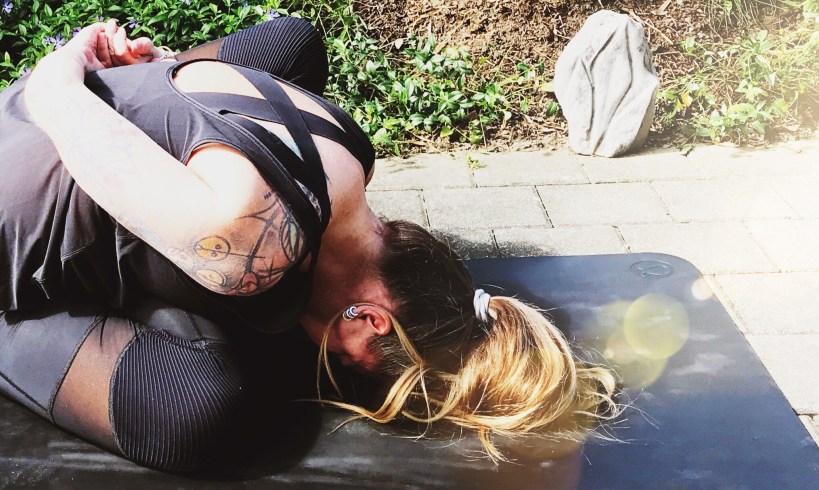
In love with Marichyasana B!

Did you know, it’s named after the sage, Marichi, which means “ray of light” – isn’t it beautiful?

It is said to stimulate and calm the brain, while stretching the spine and shoulders. As one leg is placed in half lotus, it stimulates the colon and massages the abdominal organs, such as the liver and kidneys. Marichyasana B is associated with the manipura chakra and such a great posture for taking the attention and focus inwards.

These are the facts, however, for me it’s a pose to release. There are many different things to feel, a deep stretch here, a bit of pressure there, and I can feel my body slowly accepting and releasing. I’m facing steadiness and ease like in no other posture. Rather easy, but same time complex due to the combination of half lotus and binding.

Honestly, the only asana I breathe extra slow and sometimes I find myself counting and counting…. oh 5, yeah, it was 5 breath…. 🙂


Allow your progress to unfold

Never judge your progress on physical standards. Instead feel it. The posture might look the same, but you will feel the progress. There is more, there is always more, don‘t allow any expectations or judgment to ruin your progress. Let it come naturally, without forcing. Be patient.

Find your rhythm, vibrate in your frequency, follow your pace. This is the way to smile while learning 😊😍

yes yes yes

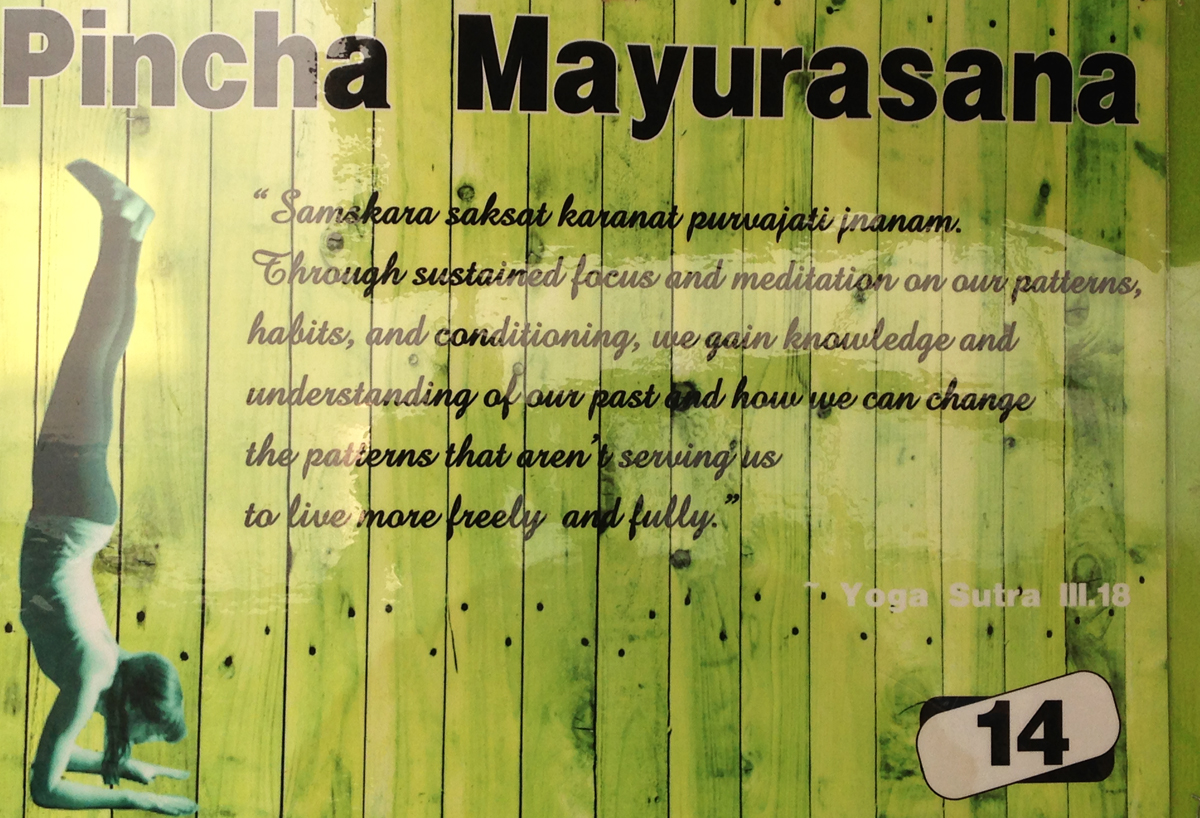
When I arrived in India for my first teacher training, I faced this plate next to the door of my room. Pincha Mayurasana was all I saw. I started panicking…. was I supposed to do this? I mean, my aim was NOT becoming a yoga teacher, I did this training just to soak up all about yoga. Well, that’s what I thought. You know quite well, I was damn wrong, as I started teaching right after my first teacher training and nothing can stop me since 🙂

Back to Pincha Mayurasana. In times of Instagram yogis, it takes some courage to state what we can’t do, rather than posting fancy postures only. Thanks god I always had amazing teachers, who never pushed, but teached. I learned, that being a good teacher doesn’t require that I can do all postures in perfection. Plus, yoga is not just postures, it’s so much more – but that’s a different story! Finally, teaching is not about me, it’s about my students.

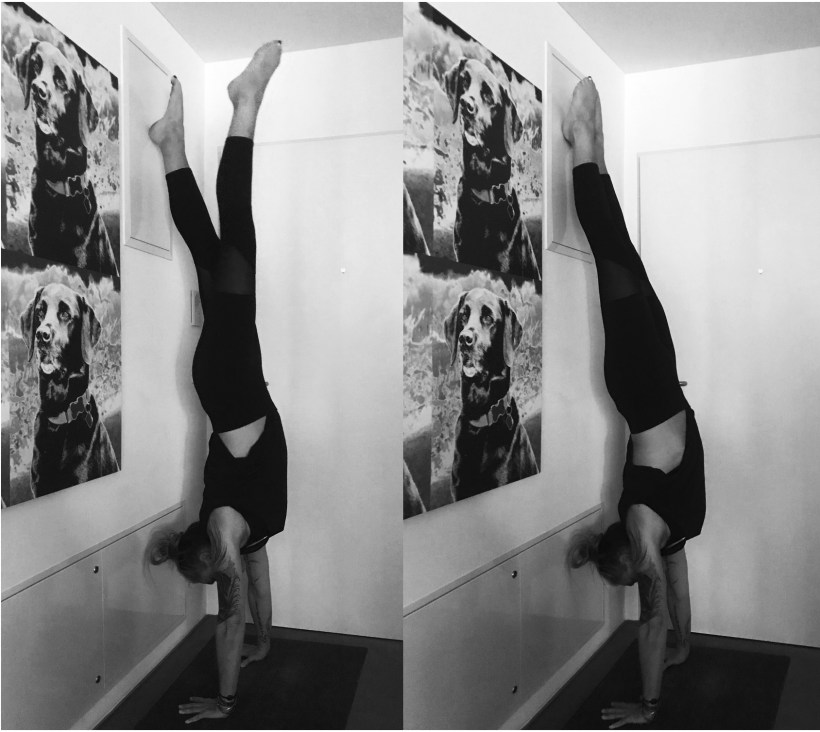
However, some months ago, I decided to work on handstand and forearm stand. I knew the technique very well, I was strong enough, but fear still stopped me. I know I have to learn slowly, as it is all about building trust. Learn how a posture feels, what happens in the body and what my mindset has to be. I focused on handstand for some time and a few days ago, I tried forearm stand once again. My work paid off, it was much easier than before. And today is the day, the first time, I managed to bring my feet off the wall in pincha. OMG. Even if only some seconds, this was a major breakthrough, as now I know that I can do it. Now it’s just a matter of practice, but I’m already there.

Once you master a posture, look back. What did the process teach you? It’s not about the posture any longer, but how you changed, what you’ve learned on the way and what you are able to do. Honestly, I believe this way of slow learning is much more beneficial than just hopping into postures by default. It’s telling me a lot about life and about myself. A process so worth it!


Listen

„It’s not about forcing or willing your body, it’s actually so much more about listening.“ Kino McGregor

I love this. It’s all about tuning in, listen and allow things to happen. Yoga is a process and to force yourself into a posture will nothing but harm your body. Well honestly, your mind too, as you might get frustrated. Do good for yourself and stop getting attached to the perfect posture.

My students know quite well how much I repeat and remind them to focus on their breath, to follow it trough their bodies and to let the breath work for them. Through your breath you can lengthen, release, you can even go much deeper into a pose. But you must go internal. This might be difficult at the beginning, particularly when in class. Give it a try anyhow.

A good preparation is to meditate. Sit quiet and bring your full attention to your breath, nothing else. Feel your breath, watch it flowing through your body, maybe you can even hear it. Sharpen all your senses focussing on your breath.

In your next class, just do the same. Listen to your teacher, let the voice be your guide through the flow of poses, while you are on your journey inwards, with your breath as your beautiful travel companion.

Be patient and allow your practice step by step to become a moving meditation.

The Truth

Think outside the box. What’s right, what’s wrong? Many of us think that they know exactly. We were educated to establish certain values; we learned the rules and we were told on how to behave. All teachers we had and still have are telling us the right way. Be aware, it’s only what they have been taught and/or what they believe in!

I’d like to encourage you to question everything. What a teacher tells you, what’s written in the books, what your parents, your partner or friends believe in. I’m not saying it’s wrong, but asking you to think about it. What does it mean to YOU, how does it fit into your world? Also ask yourself what do you believe in and is this really what you think or are you just repeating without any reflection? Not judging, but a healthy reflection, which is required to make up your own believes.

Think about it….. it’s worth it! And it’s well needed to find your own truth.

Am I talking about yoga? Of course! As a teacher, I tell my students how to access the postures, how to breathe, how to connect with their bodies and themselves. Am I telling the truth? Yes, from my point of view I do. It’s what I’ve learned and what I believe in. I don’t teach anything just following the books, it went through my reflection and is finally exactly what I believe in. Is it right for my students? If they don’t reflect and question, the answer is no. Everybody has to find ones’ own truth. All teachings are just a large bouquet of options, other people’s findings and their truth.

What about things that have been proved as right? Such as a certain medicine, that removes your pain? You might have experienced, that a medicine can help, but it doesn’t do each time. So is it true then? You decide.

Back to yoga. A simple physical example is the right posture. My opinion: there is no such thing as a perfect posture. What? Of course, we have pictures of super bendy yogis and descriptions from the great teachers and gurus –  extremely useful guides! While trying to master a posture, we have to take our body and its capability into consideration. When practicing regularly the body changes, it gets more flexible and stronger, poses become easier and closer to that image of perfect. Finally, it will always be YOUR variation of the posture, even if it looks pretty much like in the books. It might not, that’s absolutely fine. Each body is different.

There’s only one truth: YOURS.
Progress

Never underestimate your progress! Sometimes we can’t see it, but feel it. Sometimes it’s rather going backwards and the progress isn’t in the body, but in the mind.

Are there postures you wish you could do, are you trying again and again, but mostly not very successful? Well, if you really want to master a posture, it means daily practice. This is what I did with headstand. It took me one year. Each day I practiced what I could and one day, boom! I was up. And headstand became my absolute favorite posture, I’m just in love.

Now handstand moved into my focus. I know, it’s quite easy for some people, unfortunately not for me. I couldn’t even imagine me balancing on my hands ever, but there’s light at the end of the tunnel. I started walking up the wall, which showed me, that I’ve got enough strength. That’s what I did for some time, to get used to it and feel my body in this position better. But the problem isn’t my body, it’s in my head and it’s called fear. A beast not easy to handle. I took the challenge. Within one week, I managed to touch the opposite wall. Yeah. Now I can really feel the posture and what needs to be done. I feel how my body lengthens, I feel the difference when pointing my feet, when engaging the bandhas, when pushing into my hands. And I know, I will make it.

But finally, mastering a posture is just a side effect. The real progress is recognizing what happens in our body when working on a certain posture. Being aware of the effects when engaging, activating etc. It’s amazing. Also what needs to be done mentally to overcome fear. This is so important, not just on the mat, as you will take your experiences with you, whatever you do.

I’m working on my body, I’m working on my mind, I’m changing and I love it. I’m showing age my middle finger, I’m still learning and won’t stop. Progress in baby steps can be even more beneficial as just doing a huge jump.

Yogi, never underestimate what you’re doing!

Don’t skip Shavasana

There are usually two kinds of yogis: those who love Shavasana and those who skip it if any possible. Yogis, please don’t skip – and I know what I’m talking about, as I rather belong to the second group, particularly when practicing by myself at home.

Let me tell you a bit more about this final posture. Shavasana can be translated as corps pose. It’s said that Shavasana is a process of rebirth! How beautiful is that? Honestly, think about it! You are reborn after each practice…. Just this should already convince you to never skip again. But hey, there’s much more:

In Shavasana we are getting our bodies quite after practice, it’s the time to rest and release, to slip into a blissful neutrality and stillness. It’s also said that we need this time to get the practice and all learnings settled in and assimilate. Shavasana gives the nervous system a chance to integrate all the new neuromuscular information generated in the asana practice and prepares you to deal with daily life once again. So don’t underestimate the effect of this final posture.

While it looks easy, it might not be. It’s not a time to sleep and it takes practice and patience to surrender easily. It can be a challenge for the mind to get out of this “wasting of time” mode. Even if your body weaves easily into a relaxing state, allow your mind to follow. Send your thoughts away, just let them pass by. Stop moving, stop judging. Face the stillness and your own inner fear, which unconsciously rules many of your actions. Immerse into the friendly darkness and just be there, observe.

Yogis, allow Shavasana to do its work – to rejuvenate your body, mind, and spirit!

Non-Judgement

Judgement. A hard word. It might be a matter of language, but the word itself is kind of giving me a jerk. I even feel guilty without knowing why!

Are you free of judging? What about your practice? Are you looking at your neighbor in class? Analyzing what he/she is doing better? Or worse? Did you see her belly? OMG, this must be a so called 6 pack! Wait, this tiny awesome looking girl has cellulite? Thank good, not just me… oh this posture is looking so bad! Can’t believe the teacher doesn’t correct anything…. Alright, you already switched to bitching about your pears!

Well, judgement can also be directed against yourself. Thoughts such as, I wish I could wear this, but I’m to fat. I’ll never be able to do this pose, I’m just not flexible enough, I look ridiculous, I’ll never ever attend a class again… and millions more.

Are any of those sound familiar?

You know what helps? Continue practicing yoga. The purpose of yoga is purification. Yes, it’s not about being the queen/king of flexibility. It’s not about fancy asanas and poses. It’s about getting rid of all those expectations, purifying your mind and connecting to your self. Yoga is your practice to be luminous, clear, happy and focused. You won’t win a price for mastering your chaturanga. Nope. Neither headstand, no applause.

When you’re on your mat next time, starting your practice, take a couple of deep breath and let your intention be „non-judgement“. Practice for yourself. Don’t care about others, don’t even care about yourself. Listen to your teacher, breathe, flow and enjoy. Not thoughts about right or wrong, good or bad, can or can’t. Accept that everything is exactly how it should be in this moment.

Enjoy the ride yogi, just be.

It’s about people, not poses.

Some teachers teach poses; some teachers teach people. Some students want to work on their fitness, some students want to improve, grow, work on their body and mind. For some it’s work out, for some it’s magic.

What’s wrong, what’s right? Nothing. Just different approaches. We can practice yoga as a cardio workout. We can practice yoga to increase our flexibility. We can practice yoga as a moving meditation. We can practice yoga as a reflection on our body’s reaction to the work. We can practice yoga as a spiritual experience. And everything in between. There are teachers out there for each approach, nothing wrong, nothing right. No matter what you do, as long as you feel good, you’re doing it all right.

But what does it mean to teach people, rather than poses? Well, we are still talking about asana practice, meaning we go through postures in class. First priority – yes this is about poses and part of the game – is to do them correct or find a suitable modification. Not to master them, but to protect ourselves from injury. Now it’s up to you, leave it here or go to the next level, which means for me, teaching how to connect with ourselves. Go internal to feel what you are doing. Listen to your body. Respect your limitations of the day. Learn to breathe and let the breath initiates the movement to finally fly through the asanas. When holding the postures, find stability as well as ease. Enjoy what you are doing. Learn from what you can and can’t do so far. What is your body telling you? Why is there a stiffness, why does it hurt here, why isn’t there any progress? Is there really no progress? Why in a hurry?

Yoga can be so much more than bending your body into a pretzel or standing on your hands. If you just want this, absolutely fine. Go for it, it’s a great fitness tool. If you are open to receive more, get the journey started and allow yoga to change your life. To change yourself. Learn to differentiate between yourself and your ego.

Coming home

What’s your approach?

Are there any asanas driving you nuts as they appear unattainable? You’re trying again and again, but still can’t imagine to ever be able doing them? What about this thought:

It’s not the asana being exhausting, but your attitude.

Ups!

What are your expectations? Your objectives? Why is it so important? What’s going on in your head while practicing? Wanna be „perfect“? „Better“? What thoughts are holding you back?

Yep, we all got this from time to time, this feeling to not progress at all, or even worse, to not be good enough. Particularly when we can’t accomplish a posture and so want to.

Darling, be kind to yourself! Challenge yourself, but don’t push hard. Respect your limitations and stop worrying. It might be not the right time. It might require a bit more strength. Maybe it’s not even physically, but your mind, that should simply stop that noise. Be patient. Play. Laugh. Practice with a calm mind, an open heart and let go. Overthinking kills any progress. Yoga isn’t a competition. Yoga is the process of coming home. Home to yourself. 

Sri K. Patthabi Jois said: „Do your practice and all is coming“. This is the secret. Work WITH your body, not against. Allow your body to develop and progress in your own time. Feel what you’re doing. Listen to your body, connect.

Remind yourself to enjoy the ride, love! It’s your ride home.